China’s behavior has made it clear, through their aggressive behavior in the South China Sea and their policy of economic conquest implicit in the Belt and Road initiative, that they are set on a path to become the dominant power in the world.
They have enormous technological capacity, a strong commitment to further it and are equal to us in drive and inventiveness.
But they still don’t have America’s edge in many fields.
Given that China has shown its colors, why assist them in their quest for dominance?
China’s push is much determined by the bargain they have made with their people. ‘In exchange for our quick rise,’ they have said to their citizens, ‘you will give up free speech and consent to the Communist Party’s detailed surveillance of your behavior.’
The party knows that those restrictions cannot last forever and feels compelled to show results to justify the repression. That is the pressure they’re under.
Why should America assist them with their plans?
It is reasonable to assume, that China will develop what it needs technologically on their own but that will take time.
Time that we need to further our own advantages.
Time to repair the social and economic infrastructure that has kept us from providing equal opportunities to our citizens.
We need whatever edge we now have in the various fields to make our citizens stronger and better educated.
Competition with China will last decades. We need sharp minds and able bodies who are convinced that our system is fair, respectful of human rights and worth fighting for.
We need time to make clear what the American edge is.
As we produce better citizens we will likely keep that edge over China and dissuade the rest of the world from moving to their side.
There is no guarantee that will happen, so we must work hard for it.
The present administration, with its commitment to comprehensive infrastructure building, understands this need.
There will be those, however, who in the interest of profits, will make the case for accommodating with China, that is to supply them with what they wish. But those interests are shortsighted, will undermine our resolve and give China the advantage.
Competition with China is here to stay and it can help us become a better nation.
For that we’ll need inspiring leadership, bipartisan support and lots of gumption.
Your choice to waive the patents our pharmaceutical companies hold on vaccines against the coronavirus.
Yes, the world is in great need of the vaccines, but the fact that the US has developed them at great speed, owes much to the profit motive.
The fact that there were companies in place with layers and layers of expertise and knowhow to tackle the task of creating the vaccines at record speed, owes much to the profit motive.
That has to be respected because it is at the heart of the power to create.
Without those companies’ enormous outpouring of inventiveness and skills, our nation would not be protected as it is now against the ravages of the virus.
And our economy would not be on target to post a record GDP for this year.
There are ways to assist countries in need and we should do so.
But to say to the pharmaceutical companies that have invested as much as they did, that they will not be getting the anticipated reward for their efforts and the risks they took in producing the vaccine, is the wrong move.
As I understand it, trade secrets will be shared. All that work that went into creating the vaccines is then to be shared. Free.
Since we have been privileged to have the advantages we have, I agree that we ought to share them with the world. It makes sense.
But pay those who put the hard work into creating what is now granting all of us peace of mind.
Entice them to donate vaccines, if they have not done so, while also negotiating better rates for us to buy them and then turn around and give away to those in great need or at cost for those with greater means.
It is understandable that the World Health Organization and other world leaders had put pressure on you to choose as you did.
And it is understandable, that in the wake of the disastrous term of your predecessor, you are eager to rebuild our standing in the world.
But your action undercuts a crucial drive for excellence in our system.
You have proposed a very large spending bill to address all manner of ills long overdue for appropriate action.
The bill is large because everyone has to get paid.
And so do the pharmaceutical companies that went all out to get us what we now hold so dear.
Effort has to be rewarded.
You could have appealed to the companies’ good will and let them be a partner in the spreading of our nation’s good will.
You have made a bad decision.
But perhaps, it is not too late to reverse course.
They have benefitted enormously from the West, absorbing its science, technology and ways of doing things – everything they found worthwhile in every area of development – and then rose and rose, surpassing Russia and the Eurozone and pulling itself up to become a rival to America.
That they are seeking world dominance they won’t say but judging by the manner in which they carry on their appetite seems insatiable.
At no time has there been a greater challenge to democracy.
China is saying to us, ‘You cannot move up as fast as we can, and we will overcome you for we are unstoppable. We have become the factory to the world and all hurry to be part of our enormous markets.’
Turning to its people, China’s leadership says, ‘The world comes to us because they want money. We have that through our labor force, talented people and enormous markets. And because we have been so successful enriching others we have enriched ourselves. So we can make a bargain with all of you, fellow citizens. We will protect you, grant you the benefits of continued prosperity and provide you with all the conveniences of modern life. Furthermore, we promise you will grow proud as China rises to be the dominant nation on Earth. What we want from you in turn, is that you surrender your freedom of speech. We want from you, that you consent to being constantly surveilled to ensure there will be no dissent against the Chinese Communist Party. Think about this. It is a small concession to make, considering all the gains we will achieve as a united nation, not torn apart by petty political differences like in the rest of the West and particularly in America. What we, Chinese, are doing now, has never been done before. No nation has ever risen so fast from so low. We are a nation of destiny, showing the world by our actions, that we have discovered the best system to rule its citizens. For too long, Americans have believed that their system of government was the best. They speak grandly of exceptionalism. But take a good look at how they have treated their minorities, Blacks in particular, for centuries. And still they want to preach to the world. How dare they. At look at how money buys political influence. You make money and you go right to the front of the line, even if you are inept politically. Only in America can you turn an expertise in building hotels into a credential to lead a country. And Americans fell for it. And they did because they lack political education. Unlike here in our great land, where the hard working communist party, with 91 million members, devote their life to keeping the system flowing.
But back to America. Look at how they kill themselves because of their unrestricted access to guns. Take a city like Chicago – the South side – the killings go on and on, administration after administration, whether it be Obama or Trump, they just keep killing each other. And look at how poverty is widespread. As for their cultural life, sure, now and then they will make a good movie or write a good song, but we, too, are working on that. Fellow Chinese citizens, the restrictions that we have imposed on free speech and surveillance will not last forever. We estimate, that with proper political instruction and our steady development it will take us no more than another 25 years – a conservative estimate – before we become the most powerful and most advanced nation in the world. In that time, we will have achieved total superiority. And yes, everyone in America will be wanting to speak Mandarin for that is the most beautiful language the world has ever heard. Your children and your grandchildren and heirs to follow, will revere you for the sacrifices you are now making on their behalf. The fact that we will achieve superiority will not mean that we will impose our system on others, but as other nations see how effective we are they will try to emulate us. And yes, eventually Taiwan will be part of the mainland, in the same way Hong Kong is returning to our embrace. The big Panda embrace. How can you not like that feeling?
Others will follow our lead willingly, joyously, for we will lead through our example.
In America, today, Joe Biden is trying to get his citizens to renew themselves, but our leadership feels his efforts have come too late.
Joe Biden has ambitions plans for the renewal of infrastructure, for education, for research and development, but already the Republican party is objecting, so Biden’s ambitious reforms will be trimmed, which is good for China.
America is just too divided while we are united, which is our great strength.
We believe that America will not be able to make the necessary reforms to their system to catch up with us.
Let us give you one example. China tried to be part of the International Space station but we were no accepted. They were afraid we would learn too much. And so we have started to create our own. On April 28th we launched Tianhe or ‘Harmony of The Heavens,’ the first of three modules that will form our own space station by the end of 2022. Does that not make you feel proud of what our system can do?
Slowly, over time, America will acknowledge our superiority, but there will be those who will want to resort to violence. Leaders who prefer to fight an enemy without than confront the enemy within. Envious people. But we will be prepared. We are building more and more nuclear weapons to act as a deterrent.’
That is the message the Chinese leadership is giving to their people.
What will Russia do in the face of China’s rise?
Putin has cast a spell on the Russian people which has interfered with their political development but my take is that the Russian people lean more to the West than to China.
Eventually, as Russia emerges from their stupor, they will elect a more pro-Western government.
But can America answer China’s challenge?
Can we make the necessary structural changes and shine?
Can we evolve to having a dialogue amongst ourselves and eradicate racism?
Can we improve our education and health systems sufficiently that every citizen will have the opportunity they need to be the best they can be?
Can we defeat crime?
Can we stop the high level of incarceration that is a sign of poor investment in our people?
Can we stop killing ourselves?
The answer lies in pulling ourselves together and working toward a common purpose. To do it we need bipartisan leadership willing to dialogue.
All of us have to own the pain that comes from living.
The pain that comes from not having what we want, even though we have worked hard for it.
The pain of living that comes from realizing that nature gave us so much and that is it.
The pain of living that comes from recognizing others have more than we do.
The pain that comes from not having behaved as we would have liked to.
The pain of living that will not go away and yet we must learn to manage.
To manage it we have to look at it. Squarely. In detail.
And if we at first flinch or turn away, we then must take a deep breath and look again.
Look again till we understand it.
And then accept it.
Accepting it does not mean the pain will go away.
We accept so we can learn from it.
Every single one of us has to look at their own pain. No one can spare us from it.
If they offer to, say ‘thank you but no, thanks’.
Facing our pain is at the core of the journey for existence each of us embarks in when we come to this world.
Yes, it has moment of beauty. Even happiness. Moments.
And like individuals, so with nations.
Nations are more than a collection of individuals, just like the liver is more than a collection of liver cells. To make up the liver they have organized themselves according to various functions for the sake of a purpose.
And that sum total of individuals that come together to form a nation bring their individual pain with them, which adds up to the total pain of the nation.
And the pain has to be looked at. Squarely. In detail.
The pain has to be looked at again and again until we get it. We as in the people and We as in the nation.
Sharing our individual pain with another human being offers comfort, soothing and perspective. But it is our individual pain.
No one can suffer for you.
We need our pain so we can improve ourselves. Push harder. Try and be the best we can be.
Our pain is a catalyst for action. It spurs us to growth. To take chances. And when accomplishment comes then we realize what great soother it is.
But it won’t erase the pain.
It helps manage it.
Nations that don’t look at their pain cannot reach their potential.
Leaders who don’t help us look at our pain are not leaders.
They are in it for personal gain or for the gain of a special group.
There is no forward movement without owning our pain, which if allowed to grow becomes rage.
We cannot own our rage unless we understand it.
When pain or rage owns us we cannot direct it properly, and so pain not owned may lead us to blame others for our distress. And so pile additional pain upon their pain.
A nation that does not dialogue with itself is a nation that has preferred to blame others instead.
In America, the dialogue about race has been forever postponed, and it is only now moving up to the top of the list where it belongs because of circumstances.
If a young man had not videotaped the murder of George Floyd in Minneapolis, we would not have known the fullness of our anger and the officer who pinned him down until he died would have been back on the beat, searching for someone else to pin down.
Even with that, if it had not been for the coronavirus, we would have reelected the previous president.
Think about it.
If we would have reelected our previous president we would have continued to be distracted by tweets and temper tantrums, and we would have postponed, again, talking to ourselves and to others about our pain.
Pain that is not looked at and understood becomes rage.
Finally, after much concentrated effort, people with diverse skills and a history of endurance, get to be selected as finalists for the academy awards. And then the winners are announced. But there are no losers once you’ve entered that special circle. They’ve all showed remarkable ability.
But how does anyone recognize the field that if pursued with tenacity is more likely to bring recognition?
Is there an answer for everyone? Given that we are all unique, is there a road for each one of us?
I say there is, and if asked to give a common denominator to all those roads it would be this: a person knows they are on the right path for them if they are growing stronger and wiser as they pursue it.
Chloe Zhao has just won an Oscar for best director. The first woman ever and the first woman of color to be so honored. What a feat.
But in her native China, news of her accomplishment was suppressed. Why?
Apparently, some years back she had made some critical comments about how her native country was being run.
She was born in Beijing of Chinese parents, having come to this country at a young age. Why wouldn’t all fellow Chinese not be proud of what she has accomplished?
The government’s decision to devalue one of their own is a sign of what is wrong with that regime, even as China is now reaching heights it had never reached before.
For China to devalue Chloe Zhao is to say to the world, ‘if you don’t think like us you have accomplished nothing.’ What absurdity. Furthermore, it is a sign of how creativity is and will be hindered by the regime and how it will be self defeating in the end.
Autocracies, like dictatorships, seed the grounds for their self destruction by suppressing creativity. And so will China.
For us in the rest of the world, the task is to keep alive systems that enhance it. And that comes with fairness to all and equality of opportunity.
Adhere to that path and we will grow stronger and wiser, able to resolve our differences and fear nothing as we move confidently into the future.
Alexei Navalny, who’s been in prison since January after returning to Russia from Germany – where he was treated for poisoning with the nerve agent Novichok – went on a hunger strike at the end of March after prison authorities did not allow his family to visit him following his reports that he had developed back pain and loss of feeling in his legs.
The prison replied he’s receiving adequate medical care.
But two days ago, the Associated Press reported that a physician who reviewed lab results of Navalny’s brought to him by his family, says his blood levels of potassium and creatinine are elevated and puts the patient in danger of death.
Here’s the problem: Putin would not mind it one bit if Navalny dies.
But the Russian people would lose an important leader.
Supporters of Navalny should insist that he give up the hunger strike immediately.
There are fights that can’t be won and that is one of them.
The Russian people are not ready to go into an uproar if Navalny were to die now.
Much work remains to be done and for that Navalny has to be alive.
Who knows what will bring Russians out of the stupor they find themselves in, allowing a man like Putin to rule them since 1999.
But the movement that Navalny has led has been making progress, slowly confronting Russians with the denial they are stuck in.
His dying in prison won’t help.
Prisons are bad places. Who knows what kind of pressures Navalny is being subjected to by fellow prisoners at the behest of the government, which may have led to the hunger strike.
Navalny has to focus on staying alive, not gamble with his health.
His supporters need to act fast while there is still time.
The New York Times said yesterday that an open letter had been addressed to Putin by prominent personalities asking that Navalny be allowed the care needed immediately.
This morning, the Associated Press stated that demonstrations on Navalny’s behalf are planned for this weekend in Moscow and St Petersburg.
The hope is that Putin will acknowledge the request.
But there is a good chance he’ll drag his feet and, in the meantime, Navalny’s health will worsen.
I can imagine Putin in his private residence, sipping from a glass of fine wine, as he muses over the events, relishing his returning to the spotlight he so enjoyed while Trump was president.
Now Biden is getting all the attention.
‘And to think he dared call me a killer, on national television,’ says Putin to himself, referring to Biden, a feeling of bitterness rising in him. ‘And now they want me to be charitable with my enemies… their Trojan Horse… because that’s all that Navalny is, an American agent.’
He ponders the thought and then, smiling to himself, says ‘Dear Alexei… to think that I feared you would one day dethrone me.’
Putin long ago signed a pact with the Devil. He has aided the brutal repression in Burma, propped up Assad in Syria.
One day soon, the Russian people will awaken. Alexei Navalny has been trying hard to do that.
But he has to stay alive.
For that, he has to quit the hunger strike.
In addition to the letters of prominent people in his support, we must encourage the effort to have Navalny be pushed forward as the choice for this year’s Nobel Peace Prize.
Alexei Navalny, with his enormous courage, walks in the steps of Andrei Sakharov, the Russian physicist and human rights activist who won the same prize in 1975.
That award did much to raise the consciousness of the world and prepare the Russian people for the change that followed when the Soviet Union collapsed on December 26th 1991.
In the middle of the night, on March 29th, Adam Toledo was chased down an alley by an officer who’d been called to the scene by a report of shots fired in the neighborhood.
In a recently released video (April 15th – per request of Chicago’s mayor Lori Lightfoot), Adam was carrying a gun as he runs away from the officer who’s frantically shouting at him to stop.
Adam raced on for a stretch before finally halting.
Careful observers reported that he threw the gun he was carrying over a fence before turning to the officer who was holding a gun pointed at him. I could see Adam putting up his hands. Briefly.
And immediately a shot is fired wounding Adam mortally.
The gun he was carrying was found near him.
What did the officer see that he so quickly fired after Adam turned to face him with his hands up?
I do not know.
But why did you run little brother?
Why?
What were you doing at that hour of the night, with a gun in your hands?
Earlier today, as I drove home and thought of how to approach my writing this piece, I happened to pass by a Boys and Girls Club. There were kids playing out in the yard. Kids your age, exercising, having fun, dreaming of their future.
Kids not running from their lives but embracing it.
Why did you run little brother?
There wasn’t anyone around who could take you under their wing?
There wasn’t anyone who could ask what you were feeling, what you kept to yourself and didn’t want to share? No one?
Why did you run little brother?
An African American family that was interviewed by a reporter of The Wall Street Journal about the shooting, said you had extended your friendship to their son. They thought of you as kind.
Why did you run little brother?
You could’ve stopped but you didn’t.
And now you’re not with us.
Daunte Wright, age 20, didn’t stop either the other day in Minneapolis when he was being handcuffed.
And he’s not with us either.
Adam, I know you can’t hear me, but there are lots of kids your exact age out there that I wish would learn from what happened to you.
Kids who have to stop when the police says stop.
Like all of us have to.
I never met you, Adam, but I wish I had, and so do millions of Americans, of every race and gender.
We won’t know what you could’ve become. But I know you needed someone to hear you out.
Someone to hear you say, ‘I don’t understand, I’m confused. I need guidance, clarity. I need a sense of direction, a sense that it is worthwhile to have faith in my potential. And I’m not going to get that running around in the middle of the night with a gun in my hand. I’m not going to get that running from the police thinking that I can get away with it.’
Adam, I know you can’t hear me, but there are thousands of kids exactly your age out there, all going through the same experiences you did, and failing to reach out to others.
We won’t let this keep happening.
No, we won’t. We’re going to try hard.
We can’t let it happen and call ourselves an exceptional nation.
We can’t let it happen and call ourselves a first rate power.
Something is wrong, Adam. Your death reminds us of it.
We can’t keep killing each other like we do.
Like in Atlanta on March 16th, or in Boulder on March 25th or two days ago in Indianapolis. Or the never ending body count in the South side of Chicago.
I watched the video as you lay dying.
Some newspapers chose not to show it entirely. They had their reasons.
But I looked for it and found it.
And I saw you lying motionless, as the police gathered round you trying to keep you alive.
And I saw the look of horror in your bloodied face, your eyes wide open, desperately clinging to life, as if saying, ‘I can’t believe this, I was just starting out in life and now I’m dying.’
On the afternoon of April 11th, in Minneapolis, with the trial of officer Chauvin under way for the death of George Floyd, Daunte Wright is stopped by police while driving his car accompanied by his girlfriend.
He’s commanded to step out of the vehicle and does so. Three officers are present. Two African American males and a White woman.
Officers determined that there was an outstanding warrant for Mr Wright’s arrest.
Mr Wright exits his car as he’s asked to do and an officer begins to apply handcuffs but has difficulty.
Then Mr Wright, inexplicably, pulls away, gets back in his vehicle attempting to leave the scene.
In the tussle that follows a gun is pointed at him as the word Taser! Taser! is shouted. The video shows the gun held steady. Then a shot is fired. Mr Wright drives off anyway but is able to travel only a short distance before he dies from the gunshot.
The police department reviewed the video and concluded the shooting was a mistake. The lady officer had pulled out the wrong weapon when she had meant to use the Taser instead.
Pause.
Anything is possible.
Pause.
But I don’t get that a seasoned officer – the lady has been an officer for 26 years – would get confused which side she carried the Taser on and which side she carried the gun that kills people.
I don’t get that an officer would not have been responsible enough to double and triple check each time they came on duty, which side is the Taser on, which is the gun that kills people.
I don’t get that an officer would forget to do that, knowing that, in the heat of the moment, things happen very quickly and thus you will not have time to ask, ‘Now, where is it that I carry my Taser?’
I didn’t understand, either, why the cuffing of Mr Wright was so difficult and could not be completed. And why the Black officer wasn’t talking to Mr Wright as he did so. Simple talk. Like, ‘Hey man, don’t do anything crazy, we have to take you in, we have a warrant for your arrest, be cool, okay?’
Mr Wright could have been the officer’s younger brother.
Is this asking too much of the officer? Maybe. But not far away the trial of officer Chauvin was under way for the death of George Floyd. And during that horrific scene, there was at least one Black officer present, one Black officer who did not go right up to officer Chauvin and say, ‘there’s no need for the knee, let up. The man is down, he is handcuffed and no threat to anyone. Get your knee off.’
Back to Mr Wright. As he got back in the car and the gun is drawn, no one asked, ‘Is that the Taser or a gun?’
Too much to ask?
No.
In the lockers of every officer back at the station, a sign should be posted so that every time they open it they read, ‘Do you know which side is your Taser, which side is your gun?’
Too late for Mr Wright but others will benefit.
Now, to the role Mr Wright played in his death.
Why did he pull away from the arresting officer?
Why would anyone want to do that when you have officers – with guns that kill – trying to handcuff and arrest you for an outstanding warrant?
Was Mr Wright trying to prove something?
He won’t be here to tell us but it is madness.
Why would anyone want to do something like that?
Is Mr Wright an isolated case of reckless defiance in dealing with the police, or is it part of a trend? A right of passage? ‘To assert myself I have to defy a gun pointed straight at me?’
Something is wrong here.
I have not heard African American leadership calling for all their brothers and sisters, children and parents, to be cautious in dealing with the police.
But maybe I missed it. If I did, the call wasn’t loud enough or persistent enough, so try again. Please.
Try again and remind all Blacks and all of us that, yes, there is much work to be done to achieve equality of opportunity in this land but there is now, as we speak, at the helm of this country, people who are working very hard to act responsibly.
Can such actions exonerate our guilt, or that of our ancestors?
Big questions.
What price can you put on the life of a person, the damage done to forebears, the pass-on negative effects, generation after generation?
Say that a given amount we’ll call X is awarded to an African American. Does that really undo the damage? Can we then say the problem is solved, the damage has been undone?
No, we cannot say that.
The danger is that if amount X is awarded, core beliefs would not change and neither would the behaviors. Compensation without thoughtful reflection will be for naught.
On the recipients’ side, there’s the very real possibility that if monetary compensation is given, they will not use the funds properly, thus negating the intended benefits.
Should benefits then be managed by the government, as in the form of grants to educate, to house, to provide medical services, childcare?
This general direction I find more appealing.
For instance, all African American would be given subsidized access to whatever high school, vocational center, college or university they applied, provided they met certain requirements which themselves would be adjusted in consideration of hardships the applicant may have struggled with. The amount of the subsidies to depend on the preexisting financial wellbeing of each family.
This would make more sense to me.
And what of those who have no desire to attend a learning center? Shouldn’t they too have access to reparations of another form?
Say a person wanted to start a business. Grants could then be issued, provided the person goes through some training to enhance their chances of success, and which would be part of the package.
Will the rest of us feel that we are doing something special for African Americans by engaging in such an approach or a variant of?
I think we would. We would still have to be very clear that the entire program is only a gesture, a step, not intended to undo but to soften the vast multigenerational damage that has been done.
But here’s the guiding principle. The attainment of a sense of accomplishment by African Americans would be the marker of success.
When a person is able to affirm themselves in life, their field of compassion is enlarged and we become more forgiving.
Now, what about White Americans who have fared poorly in life? Who have not had educational opportunities and thus have always lagged behind?
Would they, seeing how African Americans were being assisted, not complain loudly, in word and deed, that the forces that kept African Americans oppressed have affected them also, and that if given a chance to affirm themselves in life, they too would be more compassionate and forgiving?
That would also be a valid point.
It highlights the powerful role that economic forces have played in the genesis and preservation of racism.
To have reconciliation we must have justice and economic justice is key.
Is it possible, then, to confront the root causes of racism and forge ahead?
Yes. Nation building demands it.
Providing our citizens with the tools to better educate themselves and become full participants in the economy will be central as we move forward.
Racial tensions must be addressed and we start by acknowledging that collective denial keeps us from accepting that there is a problem.
As we do so we must keep in mind that in racial matters there is no purity.
Anyone who believes they have had no racist thoughts in their life, please step forward for all to take a good look because you are a rare find.
Restraint is another important condition. While all of us ought to be vocal in discussing racial issues, all must also be willing to check uncontrollable rage because to have a fruitful dialogue we cannot insult each other.
When I picture Martin Luther King, a giant in the struggle against racism, what first comes to mind is his equanimity, his calm courage, paired with the unyielding belief that hope lies in accepting our humanity. That is where it starts.
And it is in all of us. Sometimes hidden from sight, but often shining brightly.
Consider this. At this very moment, on Mars, lies an immensely complex device able to travel from one point to another on the surface of the planet. A rover they call it, and they named it Perseverance. They called it that to acknowledge that such astounding feat of engineering is the result of cooperation, imagination, love and dedication, the ability to dialogue and trust and experiment and take chances.
So think about it.
If we can do that, surely we can address the problem of racism.
Perseverance travelled 293 million miles over 7 months to get to Mars. And it takes 12 minutes for a message sent from Earth to reach it. What a feat.
And on top of that, on April 11 (approximately), a tiny – 4 pound – helicopter that made the journey tied to Perseverance, will do a flight of its own. The first ever in Mars. It is to last only 90 seconds. And they named it Ingenuity.
What an apt name.
Sometimes it takes picturing up in space – far, far away – all of what mankind can do, to discover that with Perseverance and Ingenuity, we can solve our problems here on Earth.
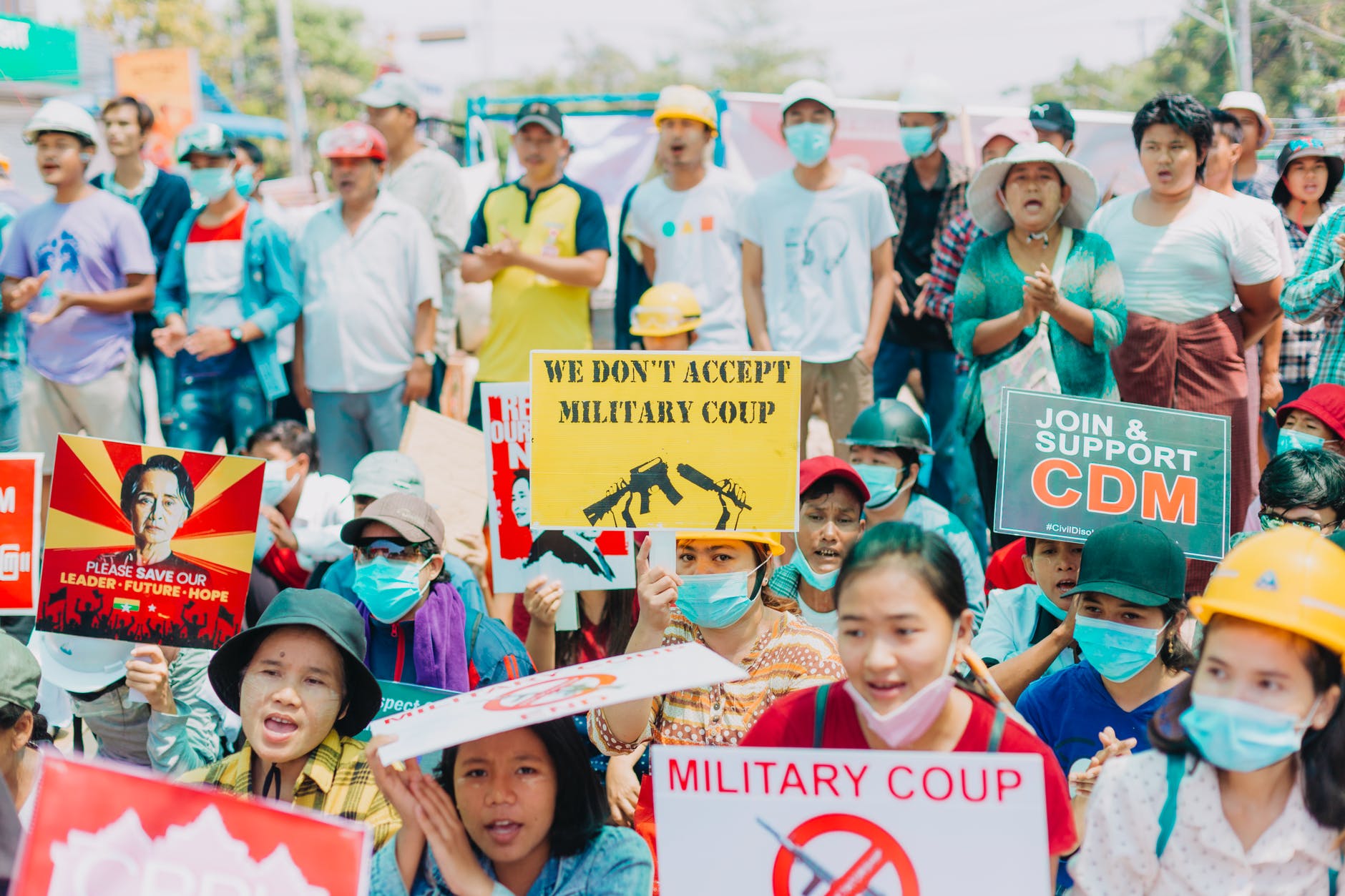
As of today, 536 citizens have been killed by the repressive forces under general Hlaing, the Burmese dictator, who seized control of the country on February 1, three months after his party had been soundly defeated at the polls the preceding November 1st.
General Hlaing did not have the decency to respect the will of his people.
But his people, undeterred, have continued to protest the general’s repressive actions in a huge civil disobedience movement.
The courage and sacrifice of the Burmese people are heroic.
You have to wonder what goes on in the mind of the general. How does he justify the killings of men and women, young and old? Just what does he say to himself in his private moments?
Does he say to himself that he is better than the protesters?
He must.
Does he look at the pictures of the men and women killed by his soldiers?
He probably does.
Only to then justify his actions.
We are left to imagine the poverty of soul of the general. His profound lack of humanity. His absence of compassion.
And we are left to wonder, how could a man like that ascend to a position of leadership? But he did.
He did because others around him lacked the courage to confront him as he rose in the ranks while sharing in the belief that, as a class, they were better than the citizens of their country.
What ghastly spectacle is taking place in Myanmar today.
And the butchering of a people goes on while the military enjoy the support of the governments of Russia and China.
What does that tell us about the dictators that rule those countries?
That they are just like general Hlaing. And were Russia and China to face an insurrection in their respective countries, their people would be treated equally ruthlessly, equally brutally.
That’s what the people in Russia and China have to look forward to.
The price of silence.
Just this past August, in the republic of Belarus, rigged election results were vehemently contested by the people, but the president of the country, Alexander Lukashenko, violently squashed the protests and refused to step down.
Of course, he travelled to Moscow to meet with his master, Putin, and get instructions.
Putin would know. He has over three decades of experience in silencing people. Three decades of experience in devaluing his fellow citizens.
Meanwhile, as fear reigns in Russia and China and other parts of the world, the deaths keep mounting in Myanmar.
And the majority of us keep watching. Shrugging it off.
But the unchecked butchering of a people does something to us.
It degrades us.
In New York City a Filipino woman was shoved to the ground and kicked in the head by a man who shouted she didn’t belong in America. There were bystanders who watched the action and said nothing.
I hear that some governments, including our own, have placed sanctions on general Hlaing, other officers and businesses owned by the military. But that’s not enough.
Is there anything the rest of us can do?
In this age of high internet connectivity, surely there is something we could possibly do.
Talk about it. Yes. That’s a start. Not let it just pass. Not simply change channels. But pause for a moment to think, how is it affecting us?
How does it affect us that the Butcher of Burma carries on with near impunity?
Should we not feel the anger?
Should we not write something about our anger at the killings? Write to our governments, to the United Nations, to the Russian and Chinese people, even to their leaders.
Could we do something… something… instead of being silent.







 Oscar Valdes